
Key takeaways:
- Sellers who perform well on Prime Day begin planning early. This includes forecasting demand, auditing product listings, optimizing content, securing inventory, and developing promotional strategies.
- Prime Day is a valuable opportunity to improve rankings, attract new customers, and gather insights that can shape a stronger Q4 strategy.
- The best results come from building awareness before Prime Day, maximizing conversions during the event, and maintaining momentum afterward through retargeting and continued campaign support.
- Accurate forecasting is essential. Both stockouts and excess inventory can hurt profitability, making inventory planning one of the most important aspects of peak-season preparation.
- Prime Day and Q4 should be used to acquire loyal customers, strengthen brand visibility, and drive repeat purchases beyond the holiday season.
For Amazon sellers, no two periods are more important than Amazon Prime Day and the fourth quarter. Together, they account for some of the highest sales volumes of the year, giving sellers the opportunity to increase revenue, improve rankings, acquire new customers, and finish the year strong.
However, success during these peak shopping events is rarely accidental. Amazon sellers who consistently outperform competitors begin planning months ahead. They optimize inventory, refine advertising campaigns, strengthen product listings, prepare promotional offers, and develop strategies that extend beyond the event itself.
A well-executed Prime Day strategy can generate momentum that carries into Back-to-School shopping, Black Friday, Cyber Monday, and the holiday season.
This ePlaybooks guide explores how you can prepare for Prime Day and how to prepare your Amazon business for Q4.

What’s new in 2026?
Amazon moved its flagship shopping event to June for the first time since 2021. Prime Day 2026 ran from June 23 to 26, a break from the July dates Amazon used from 2022 to 2025, and it was the second year in a row that Prime Day lasted four full days instead of the original two.
For the first time, Prime members could ask Alexa for Shopping to build a personalized Prime Day Deals Guide, and Prime Day came to South Africa for the first time (June 23 to 29, 2026).
Q4 2026 follows a familiar pattern. Prime Big Deal Days runs October 6 to 7, Black Friday falls on November 27, and Cyber Monday on November 30.
Preparing for Prime Day
Any smart Amazon seller knows that preparing for any major shopping event begins months ahead. Here is a preparation timeline to help you succeed on your next Prime Day:
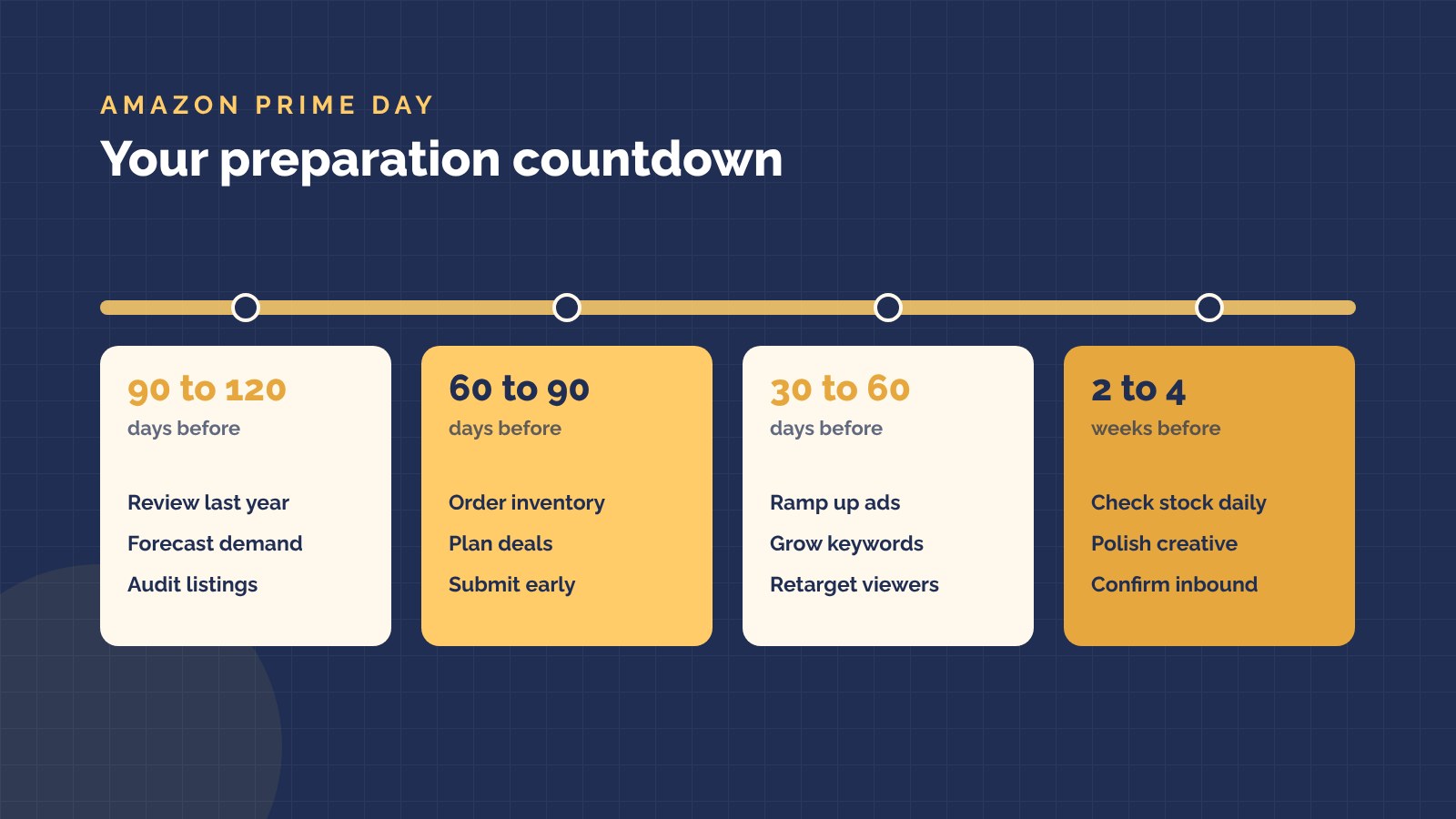
90 to 120 days before Prime Day
At this stage, your focus should be on forecasting and planning. You want to review your historical data and analyze your previous Prime Day performance, year-over-year sales trends, conversion rates, advertising metrics, inventory turnover, and some of your top-performing ASINs. Look for products that generated strong sales while maintaining healthy margins.
Next, forecast demand using what you found from your data. Avoid relying solely on average monthly sales when forecasting Prime Day inventory requirements.
Next, audit your product listings. This is where all the action happens. Review every key listing element from product titles to images, videos, A+ Content, brand story modules, product descriptions, and even backend keywords.
Nothing exposes a weak product listing like Prime Day traffic. Optimizing your product listings early can significantly improve conversion rates.
60 to 90 days before Prime Day
This is the time to finalize inventory orders. If you don’t have enough inventory during Prime Day, you can lose revenue, lower rankings on Amazon, and miss out on Buy Box opportunities. You want to build sufficient inventory buffers to account for increased demand, shipping delays, manufacturing issues, and unexpected sales spikes.
Within this period, you want to prepare your promotional strategy. Which products will receive Prime exclusive discounts? Which products will be in bundles? What products will have percentage-off promotions? Focus on products with healthy margins, strong reviews, and competitive pricing.
30 to 60 days before Prime Day
Now is the time to strengthen your advertising campaigns and start increasing visibility before the event.
Focus on Sponsored Products and Sponsored Brands, expand your keyword coverage, increase bids on top-performing terms, and identify profitable long-tail keywords. You want to promote your product collections, best sellers, and new launches.
With Sponsored Display ads, you want to retarget shoppers who viewed your products but didn't make a purchase, cart abandoners, as well as those who have previously purchased your product.
The key here is to build enough traffic before Prime Day. This can improve organic ranking and increase event performance.
2 to 4 weeks before Prime Day
Here you want to put the finishing touches. Increase inventory monitoring and track your sell-through rates, inventory health, restock limits, and inbound shipment status. You can experiment with new images, video content, enhanced A+ modules, and price positioning. Little improvements can increase your conversion rates. A 1 to 2% increase in conversion can significantly impact revenue.
Advertising strategy for Amazon Prime Day 2026
Most sellers make the mistake of concentrating their entire advertising budget on Prime Day itself, but the most effective strategy typically involves three phases: pre, during, and post Prime Day.
Phase 1: Pre-Prime Day
The weeks before Prime Day are where rankings are won or lost. Shoppers are already browsing and comparing. Your job right now is to be visible before your competition bids higher. Your goals in this phase are to:
- Increase visibility across your core categories
- Improve keyword rankings so you enter Prime Day with momentum
- Build audience awareness with shoppers who are early in their research
To get there, focus on discovery campaigns, broad and category-level keywords, and competitor targeting. You're not optimizing for immediate conversion. You're buying positioning.
Phase 2: Prime Day
This is the moment everything else was building toward. If you miss a sale, it goes to your competitors. This is not the day to be conservative with budgets.
You want to:
- Maximize conversions on your top-performing products
- Defend your rankings against competitors willing to outbid you
- Capture high-intent shoppers who are actively ready to buy
- Increase your budget significantly before the event starts.
The biggest mistakes sellers make on Prime Day are campaign exhaustion by mid-morning, missed impressions during peak hours, and lost sales that don't come back. Prime Day deal drops and shopping spikes are not uniform across 24 hours. Bids that made sense at 8 am may need adjusting by noon. Increase bids during the opening hours (midnight PDT) and midday. Use bid modifiers to protect your budget for the highest-intent dayparts. Monitor your campaigns throughout the day, not just at the start.
Phase 3: Post-Prime Day
This is where most sellers make their second big mistake. The event ends, they cut spending back to baseline, and watch their hard-won keyword rankings quietly erode over the following days.
Your goal after Prime Day is to:
- Retarget visitors who browsed but didn't convert during the event. You can recover abandoned carts and sales.
- Convert undecided shoppers. Many people research Prime Day and buy the week after.
- Maintain the ranking gains you paid to achieve.
The post-Prime Day window is one of the most underrated opportunities in the Amazon calendar. Continue supporting your winning products for at least two to three weeks after the event. The momentum you built is an asset that can help you win throughout Q4. Don't spend it in one day and abandon it the next morning.
Amazon Prime Day 2026 deals: which deal types actually work?
Running the wrong deal type is worse than running no deal at all. You spend the fee, discount the product, and still don't convert. Here are deals that are worth your attention:
Lightning Deals
Among all promotional formats, Lightning Deals continue to deliver the greatest exposure during Prime Day. These short-duration offers create urgency and receive prominent placement on Amazon’s Deals pages, making them especially effective for products with strong sales velocity and solid customer feedback. Amazon requires a Professional selling plan and an overall rating of at least four stars to create deals, and only select products qualify.
In 2026, Best Deals, Lightning Deals, and Prime Exclusive Discounts cost $100 per promotion plus 1.5% of promotional sales, with the variable fee capped at $5,000. Submitting early can earn a $50 discount on the upfront fee. For example, a Lightning Deal that generates $10,000 in sales costs $250 in total fees.
Best Deals
Best Deals prioritize longevity over urgency. Instead of concentrating traffic into a few hours, they provide visibility over an extended period, making them well-suited for established products that perform consistently throughout the year. They are particularly valuable in categories where shoppers spend more time comparing options before purchasing.
Prime-exclusive discounts
Prime exclusive discounts remain one of the simplest ways to participate in Prime Day promotions. These offers display a Prime-specific badge, making them visible only to Prime members. During events, the discount must be at least 10% below the product's reference price. They follow the same fee structure as other deals, but they don't need a featured deal slot, which makes them a flexible way to lift conversion rates and strengthen Buy Box performance during high-traffic periods. Even if you are not running featured deals, you can consider applying these discounts to your key ASINs.
Coupons
Coupons continue to be a powerful visibility driver because the green savings badge stands out directly in search results. Many shoppers actively seek coupon-enabled products during Prime Day, giving participating listings an advantage. Coupons must offer between 5% and 50% off. To create them, you need a Professional selling plan and an overall rating of at least 3.5 stars. Amazon charged $5 per coupon plus 2.5% of coupon sales in 2025, so check current fees in Seller Central, and set your coupons up a few days before the event.
Deal pricing rules: Amazon caps your deal price against a reference price. For deals, the Was Price is the 90-day median price customers paid for the product, excluding limited-time deal prices. Since May 18, 2026, Amazon also uses a Typical Price, the median non-promotional price over the last 90 days, when it checks promotions. The prices you charge in the 90 days before an event shape what you can offer during it, so plan your promotions on a calendar.
Top product categories driving Amazon Prime Day
Prime Day 2025 was Amazon's biggest Prime Day event ever, with record sales for independent sellers. Here are four categories that consistently draw heavy Prime Day traffic and where third-party sellers can win:
Electronics
Big-name products grab the spotlight during Prime Day. Apple AirPods Pro 2, the Fire TV Stick HD, and the Ring Battery Doorbell were among Amazon's best-sellers on Prime Day 2025. They drive huge sales numbers, but for most sellers, they’re not where the profits are. Margins on branded electronics tend to be very slim, and many products are still heavily affected by tariffs and supply chain costs. The brands that perform best in this category aren't always the ones offering the biggest discounts. Instead, they focus on one or two key products and support them with smart advertising. Sponsored Display campaigns, for example, can help bring in shoppers who are already browsing related products.
For most third-party sellers, the real opportunity is in accessories and products that fit into larger ecosystems. When Amazon heavily discounts an Echo Dot, demand often increases for compatible smart plugs, smart bulbs, and other Alexa-enabled devices.
Sellers who target keywords like "Echo compatible" and "works with Alexa" before the event can capture some of that traffic without competing directly against Amazon on price.
If you're selling consumer electronics, think beyond your own brand keywords. Look at the products and ecosystems your customers are already buying into and build your advertising strategy around them.
Health, beauty, and personal care
Health and beauty remain one of the most predictable Prime Day categories when it comes to building a successful promotion strategy. Many beauty brands use Prime Day discounts to encourage shoppers to enroll in Subscribe & Save programs. A customer who subscribes to a product often generates far more value over time than someone who makes a single purchase.
Focus on one or two products with strong reviews, offer a meaningful discount (we recommend at least 20%), and pair it with a Subscribe & Save incentive. When evaluating performance, pay attention to customer lifetime value, not just Prime Day profitability.
Another area many beauty brands overlook is Sponsored Brand Video. Shoppers often compare several similar products before making a decision. A short product video can help your listing stand out and communicate benefits much faster than static images alone.
Home and kitchen
Brands like Shark and Ninja tend to dominate Prime Day headlines. Products such as robot vacuums and air fryers consistently rank among the event's top sellers.
However, most third-party sellers don't need to compete directly with these major brands to benefit. When popular products bring more shoppers into a category, related products often see increased traffic as well. For example, when robot vacuums are selling in large volumes, shoppers also look for replacement filters, vacuum bags, cleaning solutions, and other complementary products. If you are in these sub-categories, you can benefit from the increased demand without entering a price war.
Another trend worth watching in Home & Kitchen are the products related to cleaning, organization, and storage often receive an extra boost around Prime Day because shoppers are in a "fresh start" mindset during the summer. At the same time, back-to-college shopping begins to pick up. If you sell storage bins, organizers, or dorm essentials, this timing can work strongly in your favor.
Pet supplies
Pet supplies continue to be one of the most overlooked Prime Day categories, despite delivering strong results year after year.
What makes this category especially attractive is customer loyalty. Once pet owners find a product that works well for their dog or cat, they tend to keep buying it. That creates excellent opportunities for repeat purchases and Subscribe & Save enrollments.
Remember, Prime Day isn't just about making immediate sales. It's about acquiring long-term customers who will continue ordering throughout the year.
One strategy that works particularly well is pairing a Prime Day discount with a Subscribe & Save offer. For example, a customer might purchase a 30-day supply during the event and then sign up for automatic deliveries moving forward.
If you're selling in the pet category, don't focus solely on Prime Day revenue. Pay close attention to how many new subscribers you gain. Those customers may end up being far more valuable than the sales generated during the event itself.
Check out: Amazon Fresh: What is It and How Does It Work?
Planning your Q4 strategy
Some sellers mentally put Q4 for much later in the year. That's a mistake. Q4 isn't just Black Friday and Christmas. Back-to-school season drives strong traffic in electronics-adjacent, home organization, and family products. Mid-August is typically the deadline for placing manufacturing orders that need to arrive for Q4.
In October, it’s Halloween, and then Thanksgiving weekend in November, and straight through last-minute holiday purchases in late December. That's months of high consumer spending. Sellers who wait until October to start preparing are already behind those who started in July.
You want to use Prime Day as your Q4 dress rehearsal and fix those things before the stakes get higher.
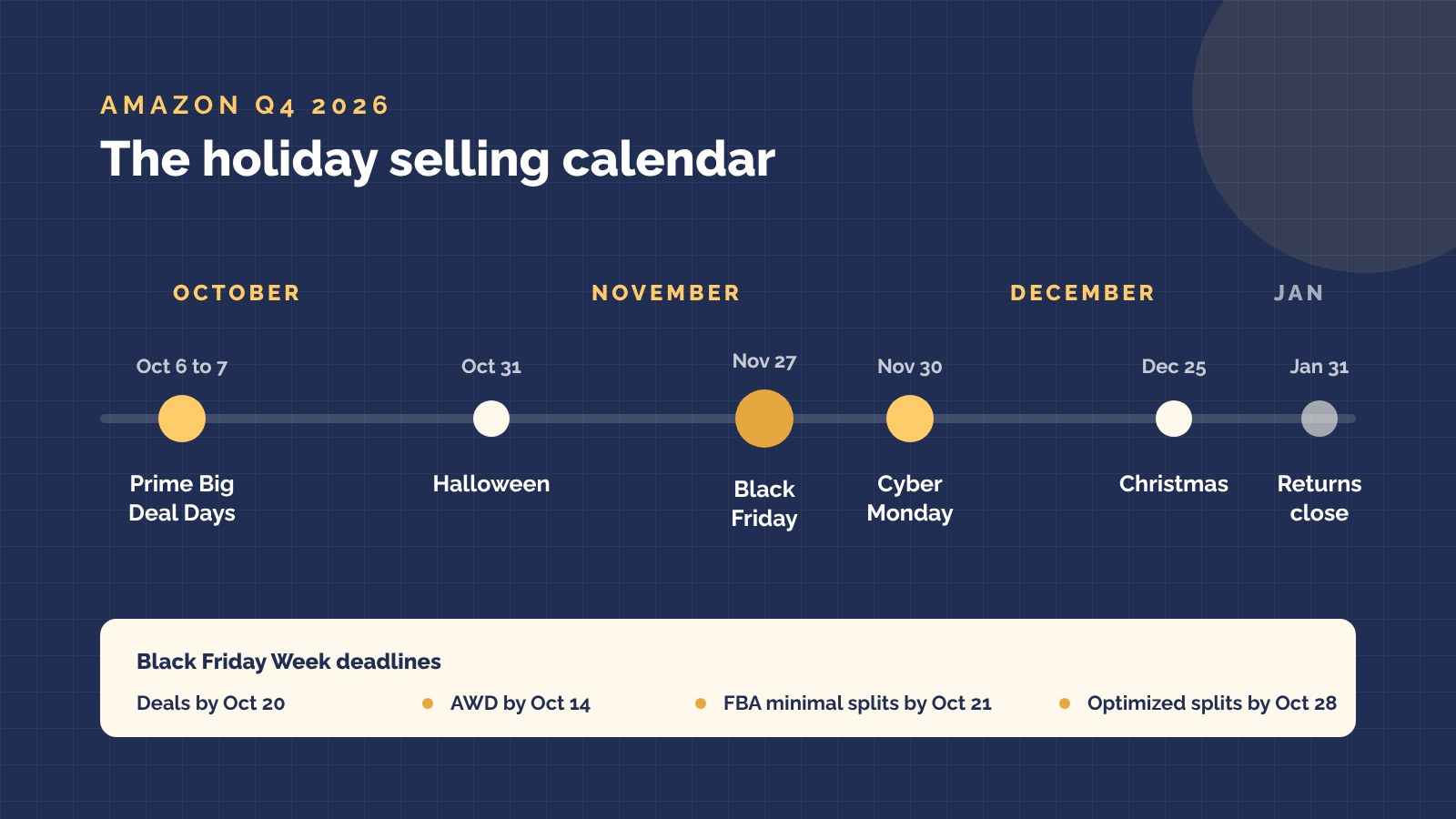
Here are the key Q4 dates to plan around:
| Event | Date | What to focus on |
|---|---|---|
| Prime Big Deal Days | October 6 to 7 | Early holiday shoppers and Prime-exclusive deals |
| Halloween | October 31 | Costumes, decorations, party supplies, and candy |
| Black Friday | November 27 | Biggest deal day; start of Cyber Week |
| Cyber Monday | November 30 | Online deals, especially electronics and gifts |
| Holiday shopping | December 1 to 24 | Gift buyers and last-minute shoppers |
| Holiday returns window | Through January 31, 2027 | Returns on items bought November 1 to December 31 |
Leveraging Prime Day data to win Q4
Prime Day isn't just a sales event. It's a data goldmine, and if you treat it that way, you can show up to Q4 with a plan while everyone else is still guessing.
Here's how to prepare for Q4, pulling from your Prime Day performance:
- Which ASINs actually moved?
- Which keywords converted (not just clicked)?
- Which creatives drove the most action?
- What did your real advertising ROAS and customer acquisition costs look like?
You can go one step further and look at repeat purchase behavior. Are the customers you just acquired coming back, or were they one-time deal hunters? That distinction matters for how you budget going into the holiday season. This data is the foundation of your entire Q4 strategy.
Inventory planning for Q4
Demand spikes during Q4 in ways that can genuinely catch you off guard if you haven't planned for them. The right approach is to build a base-case forecast using your Prime Day sales, historical holiday data, and any market trends you're seeing, and then layer on a best-case scenario and a contingency plan alongside it.
Ship your Q4 inventory batch covering Prime Big Deal Days through Cyber Monday, and work back from Amazon's 2026 deadlines:
| Deadline | Prime Big Deal Days | Black Friday Week and Cyber Monday |
|---|---|---|
| Deal submission window | July 8 to September 8 (save $50 by August 5) | July 8 to October 20 (save $50 by September 5) |
| AWD inventory arrival | September 2 | October 14 |
| FBA arrival, minimal shipment splits | September 9 | October 21 |
| FBA arrival, Amazon-optimized splits | September 16 | October 28 |
Parcel shipments need transit time plus a buffer, so ship well before these dates. Submit deals early, as deal slots are limited.
Not every product deserves the same investment. Focus your inventory budget on the products that already have proven demand, convert consistently, and generate your best margins. Spreading inventory budget thin across your whole catalog in hopes that everything pops is how you end up either stockout on your best products or sitting on dead weight in January.
Optimize your listings for Q4
Holiday shoppers think differently from Prime Day shoppers. Prime Day is deal-hunting. Holiday shopping is often gift-buying for someone else, under time pressure, with emotional stakes attached. Your listings should reflect that shift.
Think about adding gift-focused imagery, seasonal messaging, and holiday-themed A+ Content. Highlight bundle opportunities and giftability. Lead with convenience, fast delivery, and value. Give your Amazon Storefront a holiday refresh too, with gift guides and seasonal hero images. If your listing still reads like a generic product page in November, you're leaving conversions on the table. The shopper who's buying a gift for their mom wants to feel confident they're picking the right thing.
Black Friday and Cyber Monday
BFCM is still one of the most important retail moments of the year, but it's easy to get sucked into a discounting spiral that looks like revenue but actually destroys margin. Before you slash prices, run the math. Factor in your advertising costs (which will be higher than usual), your inventory availability, and what discount level actually makes sense given your profit goals. The biggest discount isn't automatically the best strategy. Sometimes a modest offer with strong creative outperforms a deep cut that kills your economics.
On the advertising side, expect competition to spike hard. This is not the time to be conservative with your budget. Concentrate spend on your highest-converting keywords, your best-performing ASINs, and remarketing audiences who've already shown interest. One of the most common BFCM mistakes is setting a daily cap that causes your campaigns to go dark mid-afternoon on the busiest shopping day of the year.
Keep in mind that Black Friday (November 27) and Cyber Monday (November 30) are no longer single-day events. The "Cyber Week" window now spans 5 to 7 days of sustained elevated traffic. This is your make-or-break for Q4 performance. Missing inbound inventory deadlines here means lost Prime badge, search demotion, and exclusion from high-visibility placements during peak traffic days.
You can check out our guide on the Amazon Black Friday strategy for US sellers for more on preparing for Cyber Week.
Holiday ad strategy
Once you're in the holiday window, search behavior shifts in ways you can take advantage of. Shoppers aren't just looking for products; they're searching for gifts by category, recipient, and price point. That means gift keyword campaigns ("gifts for dads," "Christmas gifts under $50," "holiday gift ideas") can perform extremely well even for products that don't normally win on those terms.
Competitor targeting is also worth exploring. Holiday shoppers are often actively comparing options, so showing up when someone is browsing an alternative brand is a legitimate win. And retargeting becomes especially powerful in the final two to three weeks before Christmas, when people who viewed your product earlier in the season are now in full purchase mode and just need a nudge.
Win and protect the Buy Box
During the holiday season, Buy Box ownership is even more valuable because traffic is higher and shoppers are ready to buy. Keep your best sellers in stock, keep prices competitive, and use FBA or Seller Fulfilled Prime so your offers carry the Prime badge. Monitor your Buy Box share closely, and consider a repricer so you stay competitive without checking prices by hand.
Plan for holiday fees and returns
Holiday costs go up in Q4. FBA monthly storage fees are higher from October to December, and in 2026 Amazon applies a holiday peak fulfillment fee from October 15, 2026 to January 14, 2027 (an average of $0.32 per unit). Build these into your pricing before you set holiday discounts.
Returns rise too. Under Amazon's 2026 holiday return policy, most items bought between November 1 and December 31, 2026 can be returned until January 31, 2027. Make sure your listings set accurate expectations to reduce avoidable returns, and plan your cash flow around them.
Prepare for more customer messages
Holiday orders bring more questions, more time-sensitive shipping requests, and more returns after Christmas. Aim to answer buyer messages within 24 hours and set up templates for common questions. If you use FBA, Amazon handles most customer service, but FBM sellers should plan for a big jump in volume.
Customer retention during Q4
Everyone talks about customer acquisition during Q4, and it matters. But the brands that build real long-term value are the ones also focused on what happens after the sale.
Encourage shoppers to follow your brand on Amazon. Push Subscribe & Save where it makes sense for your product category. Think about your product ecosystem: are there complementary items you can surface that would make a repeat purchase feel natural? Most importantly, just execute well. Use accurate listings, reliable inventory, fast fulfillment, and responsive support. It sounds basic, but a smooth post-purchase experience is genuinely the highest-leverage thing you can do for review generation and repeat purchase rates.
Q4 brings many new customers to your brand, but how many of them stick around in Q1 is largely up to you.
Plan your post-holiday clearance
Don't let excess holiday stock sit in FBA through Q1 collecting storage fees and dragging down your Inventory Performance Index (IPI). Amazon says an IPI score of 400 or above helps you keep healthy storage capacity. Plan a January clearance campaign for seasonal stock, and use your holiday sales data to decide what to reorder for next year.
Common Prime Day and Q4 mistakes to avoid
Prime Day and Q4 can be incredibly profitable, but they can also expose weaknesses in your Amazon strategy. Every year, sellers leave significant revenue on the table not because demand isn't there, but because they make avoidable mistakes before, during, and after these major shopping events.
Here are the most common pitfalls to help you prepare more effectively and maximize both sales and profitability.
Waiting too long to prepare
One of the biggest misconceptions among sellers is that Prime Day and holiday preparation can wait until a few weeks before the event. In reality, peak-season success is often determined months in advance.
Inventory production, shipping timelines, listing optimizations, promotional approvals, and advertising strategy all require significant lead time. The brands that consistently perform well during Prime Day and Q4 typically begin planning several months ahead. Early preparation provides more flexibility, better forecasting accuracy, and fewer last-minute surprises.
Poor inventory planning
Inventory mistakes can be expensive in either direction. Running out of stock during Prime Day, Black Friday, or Cyber Monday can result in lost sales, declining organic rankings, wasted advertising spend, and reduced Buy Box visibility. Once momentum is lost during a major shopping event, it can be difficult to recover.
On the other hand, overestimating demand can leave sellers with excess inventory, increased storage fees, and cash tied up in products that may take months to sell through.
You want to strike a balance between avoiding stockouts and maintaining healthy inventory turnover. This requires accurate forecasting based on historical sales data and market trends.
Ignoring Prime Day advertising data
You can collect significant data after Prime Day. Many sellers focus solely on event revenue and fail to analyze the insights generated from their advertising campaigns. This is a missed opportunity because Prime Day often reveals which keywords, audiences, products, and creatives perform best under high-traffic conditions.
The information gathered during Prime Day should directly influence your Q4 strategy. Winning keywords can be scaled during Black Friday and Cyber Monday. High-converting products can receive additional inventory investment. Strong-performing campaigns can be expanded, while underperforming ones can be optimized or paused.
Neglecting post-event optimization
Many sellers make the mistake of treating Prime Day, Black Friday, or Cyber Monday as finish lines. Once the event ends, they reduce advertising budgets, stop monitoring listings, and move on to other priorities. Unfortunately, this often results in lost rankings and missed opportunities.
The weeks immediately following major shopping events can be just as important as the events themselves. Products that gained visibility, reviews, and keyword rankings should continue receiving support to maintain momentum.
After each event, you want to evaluate performance, identify winning strategies, and make adjustments based on the data collected. Brands that maintain momentum after major events often see stronger long-term growth than those that focus solely on event-day sales.
Read also: 10 Ways to Find What's Trending on Amazon Right Now (2026 US Guide)
Letting account health slip
A suspension or listing suppression during peak season costs far more than at any other time of year. Higher order volume can quickly push up your order defect rate or late shipment rate. Check your Account Health dashboard at least weekly during Q4 and fix any policy warnings right away.
Testing untried strategies at peak
Q4 is the time to scale what already works, not to experiment. Test new tools, ad structures, and pricing strategies earlier in the year, then roll out the winners when traffic peaks.
Measuring success: Metrics that matter
To improve future Prime Day and Q4 performance, you need to measure results consistently. Tracking the right metrics provides valuable insight into what's working, what needs improvement, and where future opportunities exist.
Sales metrics
Sales metrics help evaluate overall business performance during peak shopping periods.
Key sales metrics include Revenue, Units sold, Average order value (AOV), Year-over-year growth, and percentage of sales from promoted products. These numbers provide a high-level view of the event's success and overall demand.
Advertising metrics
Advertising often represents one of the largest investments during Prime Day and Q4, making performance tracking essential. Monitor your ROAS (Return on Ad Spend), ACOS (Advertising Cost of Sales), TACoS (Total Advertising Cost of Sales), Click-through rate (CTR), Cost per click (CPC), and Conversion rates. This will help you determine whether your advertising spend is generating profitable growth.
Listing performance metrics
Even small improvements in listing performance can have a significant impact when traffic volumes surge.
You want to track conversion rate, sessions, page views, organic keyword rankings, Buy Box percentage, and customer engagement metrics. Understanding how shoppers interact with your listings can help you uncover opportunities for optimization.
Inventory metrics
Inventory management plays a critical role in both profitability and customer satisfaction, especially during Q4. Some important inventory KPIs to look out for include sell-through rate, inventory turnover, stockout frequency, days of inventory remaining, restock lead times, and excess inventory levels.
If you need hands-on support managing your Q4 campaigns and metrics, you can work with ePlaybooks' Amazon account management service.
See also: Why You Need An Agency to Manage Your Amazon Store
See also: How to Answer Customer Questions on Amazon
See also: 6 Smart Ways For Amazon Sellers to Leverage Q1 Peak Season
Final thoughts
Amazon Prime Day and Q4 represent the most important revenue-generating opportunities of the year for many sellers. However, success in 2026 will depend less on short-term tactics and more on long-term planning.
The strongest sellers will begin preparing months in advance, optimize listings before traffic surges, secure sufficient inventory, build data-driven advertising strategies, and use Prime Day insights to fuel Q4 growth. If you’re ready to create a solid Amazon Prime & Q4 strategy tailored to your business, you can work with experts at ePlaybooks.

