Walmart Fulfillment Services (WFS) vs. Self-Fulfillment: Which Makes US Sellers More Money
Choosing between Walmart Fulfillment Services and self-fulfillment? Compare WFS fees, Inventory Performance Score factors, and fulfillment costs to find out which model makes US Walmart sellers more money.
In This Article
Key takeaways:
Choose your fulfillment strategy based on profitability, not just costs. While Walmart Fulfillment Services (WFS) charges fulfillment and storage fees, it can increase overall profits through faster shipping, improved customer trust, and reduced operational workload. Self-fulfillment may be more profitable for sellers with established logistics operations or oversized products.
Evaluate not only WFS fees but also self-fulfillment expenses such as warehouse rent, labor, packaging, shipping, customer service, and returns to determine which option delivers the highest net profit.
Monitoring inventory levels, replenishing stock on time, and minimizing aged inventory can help improve your IPS, reduce the risk of listing suppression, and maintain product visibility in Walmart Marketplace search results.
Walmart Fulfillment Services (WFS) or self-fulfillment — which makes US sellers more money? The short answer: WFS typically generates higher net profit for sellers focused on scaling, while self-fulfillment delivers stronger margins for businesses with established logistics operations and discounted carrier rates. The right choice depends on your product size, order volume, warehouse costs, and growth goals. This guide breaks down the 2026 WFS fee structure, total cost comparison, and the inventory performance factors that determine which fulfillment model is most profitable for your Walmart Marketplace business.
After getting started selling on Walmart Marketplace, one of the first operational decisions you'll make is whether to use Walmart Fulfillment Services (WFS) or manage orders through self-fulfillment. WFS allows Walmart to handle inventory storage, order fulfillment, shipping, returns, and customer service on your behalf. Self-fulfillment, on the other hand, gives you complete control over your inventory and logistics but also places the responsibility for storage, packing, shipping, and customer support on your business.
Neither option is universally better. WFS can help boost product visibility, improve delivery speeds, and simplify operations. At the same time, self-fulfillment may offer greater flexibility and lower costs for certain products or businesses with established logistics networks. The most profitable choice depends on factors such as your product size, sales volume, fulfillment costs, inventory management, and overall business goals.
In this ePlaybooks guide, we'll compare Walmart Fulfillment Services and self-fulfillment, break down the latest WFS fees, and help you determine which fulfillment model is most likely to maximize profits for your Walmart Marketplace business.
Oops! Something went wrong while submitting the form.
What is Walmart Fulfillment Services (WFS)?
Walmart Fulfillment Services (WFS) is Walmart's end-to-end fulfillment solution that allows Walmart sellers to outsource inventory storage, order fulfillment, shipping, returns, and customer support to Walmart.
The service functions similarly to Amazon FBA. If you are looking at how WFS compares to Amazon FBA for US sellers, you will see many similarities. Both programs offer outsourced storage, picking, packing, shipping, returns, and customer support.
With WFS, sellers ship inventory to Walmart fulfillment centers, and Walmart stores the products until customers place an order. Once an order is received, Walmart picks, packs, ships, and delivers the item while also handling eligible customer service inquiries and returns.
Products fulfilled through WFS are eligible for Walmart's fast-shipping promises, helping sellers meet customer expectations without managing day-to-day fulfillment operations.
How Walmart Fulfillment Services works
The WFS process is straightforward:
Create and convert eligible Marketplace listings to WFS.
Prepare and ship inventory to designated Walmart fulfillment centers.
Walmart receives and stores your inventory.
When a customer places an order, Walmart picks, packs, and ships the product.
Walmart manages eligible returns and customer support while updating inventory levels in Seller Center.
Because inventory and order processing are managed within Walmart's logistics network, sellers can spend more time sourcing products, optimizing listings, and growing their business instead of handling warehouse operations.
What is Self-fulfillment on Walmart Marketplace?
Self-fulfillment means you manage every aspect of the fulfillment process yourself or through a third-party logistics (3PL) provider.
Instead of sending inventory to Walmart warehouses, products remain in your own warehouse or a fulfillment partner's facility until a customer places an order. You are responsible for picking, packing, and shipping orders on time, updating tracking information, processing returns, and maintaining Walmart's seller performance standards.
Self-fulfillment gives you greater flexibility and control over inventory management. You can choose your preferred shipping carriers, customize packaging, and avoid WFS storage fees. However, you need reliable logistics processes to meet Walmart's strict delivery expectations and maintain high seller performance metrics.
If you have established fulfillment operations or specialized products that require custom handling, self-fulfillment can be a cost-effective alternative to WFS. However, if you are a new seller, you can streamline operations and leverage the customer trust associated with WFS.
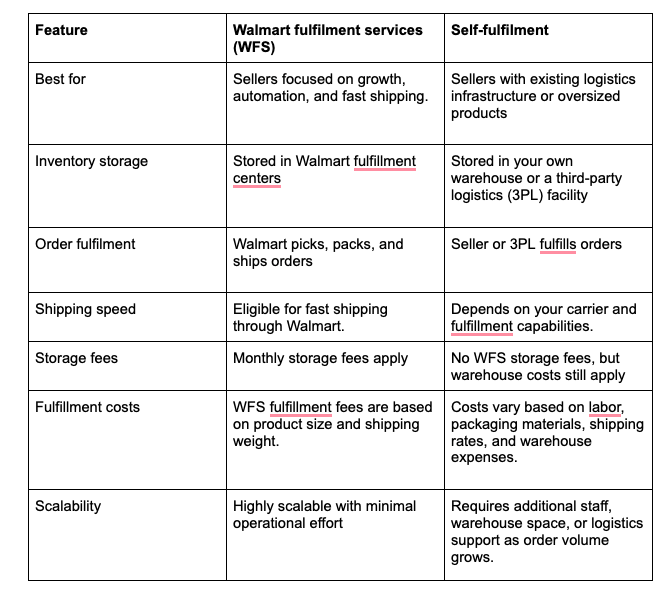
Walmart Fulfillment Services (WFS) vs. Self-fulfillment: A side-by-side comparison
Both Walmart Fulfillment Services (WFS) and self-fulfillment can be profitable, but they generate profits in different ways. WFS helps sellers increase operational efficiency and improve conversion rates by leveraging Walmart's fulfillment network, while self-fulfillment gives sellers more control over logistics and potentially lower fulfillment costs.
Before deciding which model is right for your business, it's important to understand how they compare across the factors that impact profitability.
When is WFS more profitable?
Although WFS charges fulfillment and storage fees, many sellers find that it generates higher overall profits because it can increase sales while reducing operational costs.
WFS may be the better option if you:
Sell products with consistent sales velocity.
Want to qualify for Walmart's fast-shipping benefits.
Have limited warehouse space or fulfillment staff.
Plan to scale your Walmart Marketplace business quickly.
Prefer outsourcing shipping, returns, and customer support.
For growing businesses, the additional sales generated through faster delivery and improved customer trust often offset the cost of WFS fees.
When is self-fulfillment more profitable?
Self-fulfillment may be the more profitable option when fulfillment costs through WFS exceed your internal operating costs.
It is often a better fit for sellers who:
Already own or lease warehouse space.
Have negotiated discounted shipping rates with carriers.
Sell oversized, bulky, or slow-moving products.
Need customized packaging or branded inserts.
Want complete control over inventory and fulfillment operations.
If your business already has an efficient logistics network, self-fulfillment can reduce per-order costs and improve margins without sacrificing service quality.
Walmart Fulfillment Services (WFS) fees in 2026
One of the biggest factors when deciding between Walmart Fulfillment Services (WFS) and self-fulfillment is cost. While WFS eliminates many operational responsibilities, sellers pay fulfillment and storage fees that can affect their profit margins.
Walmart updated its WFS pricing structure in September 2025, adjusting fulfillment fees across several shipping weight bands while continuing to offer competitive pricing for standard-size products. Before enrolling in WFS, it's important to understand how these fees apply to your products and how they compare to the cost of managing fulfillment yourself.
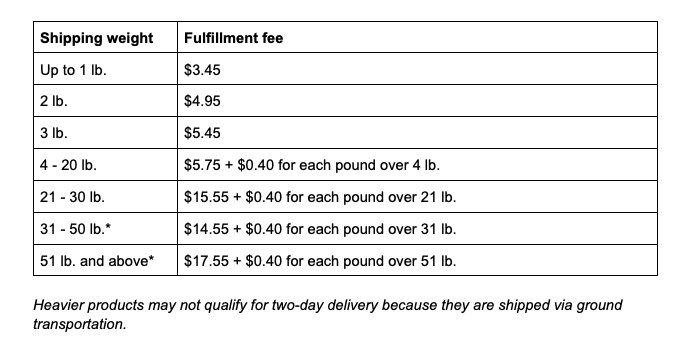
WFS fulfillment fees
Fulfillment fees are charged for every customer order shipped through Walmart Fulfillment Services. The fee is based primarily on the product's shipping weight and dimensions and covers picking and packing, shipping and delivery, packaging materials, and customer order processing.
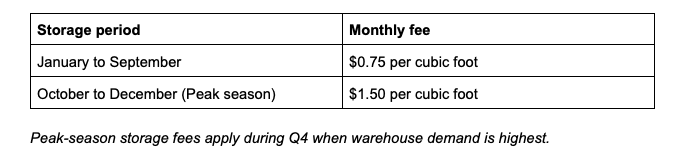
Monthly storage
In addition to fulfillment fees, WFS charges monthly storage fees based on the amount of warehouse space your inventory occupies. Storage costs vary throughout the year, with higher rates during the holiday season when warehouse demand increases.
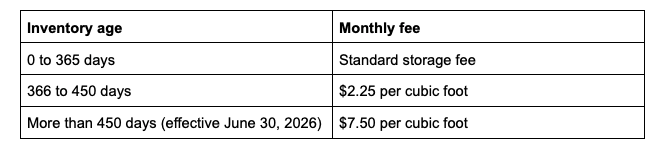
Long-term storage fees
To encourage healthy inventory turnover, Walmart charges additional fees for inventory stored for extended periods.
Other WFS fees to consider
Depending on your inventory and fulfillment activity, additional charges may apply, including:
Removal or disposal fees for inventory returned or discarded from fulfillment centers.
Returns processing fees for eligible product categories.
Special handling fees for oversized or non-standard items.
While these charges may seem small individually, they can add up quickly if inventory turnover is low.
How WFS fees compare to self-fulfillment costs
Although self-fulfillment avoids WFS fees, it doesn't eliminate fulfillment expenses. Sellers are still responsible for costs such as:
Warehouse rent or storage space
Labor for picking and packing orders
Packaging materials
Shipping carrier fees
Inventory management software
Returns processing
Customer service
For many businesses, these operational costs equal or even exceed the cost of using WFS, particularly as order volume increases.
Which fulfillment option makes US sellers more money?
The answer depends on more than fulfillment fees alone. Many sellers compare WFS and self-fulfillment based only on storage and shipping costs, but true profitability also depends on factors such as conversion rates, customer satisfaction, advertising efficiency, and operational expenses. For example, WFS may cost more per order, but faster shipping and stronger customer confidence can increase conversions and repeat purchases, resulting in higher overall revenue. The ability to scale efficiently can often offset the additional cost of WFS.
Instead of comparing fulfillment fees in isolation, calculate your total cost per order, including labor, storage, shipping, software, and overhead. Then compare that figure with the additional sales and operational efficiencies WFS can provide.
On the other hand, sellers with optimized warehouses and low shipping costs may achieve better margins through self-fulfillment while maintaining Walmart's performance standards.
When evaluating which option is more profitable, consider factors like:
Total fulfillment and storage costs
Shipping expenses
Warehouse labor and operating costs
Customer service and returns
Inventory costs
Product conversion rates
Average order volume
Sell-through rate
Ability to scale during peak seasons
Instead of asking, "Which fulfillment method is cheaper?", ask "Which fulfillment method generates the highest net profit after all operating costs and increased sales are considered?" For many growing Walmart Marketplace sellers, the answer is WFS. For others with mature logistics operations, self-fulfillment may continue to deliver stronger margins.
Inventory Performance Score (IPS): Why it matters for Walmart sellers
Whether you decide to use WFS or self-fulfillment, navigating the Walmart Seller Center for inventory and order management is essential for maintaining smooth operations. Seller Center provides inventory reports, replenishment recommendations, order tracking, and performance dashboards that help sellers monitor stock levels, process orders, and identify inventory issues before they affect sales.
One of the key metrics sellers should monitor is the Inventory Performance Score (IPS). The Inventory Performance Score is a metric in Walmart Seller Center that evaluates how efficiently you manage inventory. It helps sellers identify inventory issues before they affect product availability, customer experience, and overall account performance.
A healthy IPS indicates that you're maintaining the right inventory levels to meet customer demand without accumulating excess or aging stock.
What factors affect your Inventory Performance Score?
While Walmart doesn't disclose the exact scoring formula, your IPS is generally influenced by several inventory health metrics, including:
In-stock rate: How consistently your products remain available for purchase.
Sell-through rate: How quickly inventory sells relative to the amount you have in stock.
Aged inventory: The percentage of inventory that remains unsold for an extended period.
Inventory accuracy: Whether your available inventory matches the quantities reported in Seller Center.
Replenishment efficiency: How effectively you restock inventory to avoid both stockouts and overstocking.
Monitoring these metrics regularly helps sellers make better purchasing decisions and maintain healthier inventory levels throughout the year.
How a poor Inventory Performance Score can affect your business
Reduced product visibility in Walmart Marketplace search results.
Lower customer confidence due to frequent stockouts.
Missed sales opportunities during high-demand periods.
Overstocking that increases storage costs and ties up working capital.
Listing suppression for inventory-related issues if products repeatedly become unavailable or fail to meet Walmart's inventory standards.
Maintaining a healthy IPS helps ensure your products remain available to shoppers while reducing the risk of inventory-related performance issues.
Tips to improve your Inventory Performance Score
Whether you use WFS or self-fulfillment, these best practices can help improve your inventory performance:
Forecast demand using historical sales data and seasonal trends.
Monitor inventory levels weekly to identify fast- and slow-moving products.
Replenish inventory before stock levels become critically low.
Remove or discount aging inventory to improve sell-through rates.
Use inventory management software to synchronize stock levels across all sales channels.
Regularly review Walmart Seller Center reports to identify inventory risks and opportunities.
While your Inventory Performance Score focuses on inventory health, other Walmart seller metrics that affect your account standing include On-Time Delivery Rate (OTD), Valid Tracking Rate (VTR), Cancellation Rate, Return Rate, Customer Response Time, and Order Defect Rate.
Restock planning recommendations for Q4 2026
The holiday shopping season is one of the busiest periods on Walmart Marketplace, making inventory planning more important than ever. Running out of stock during Black Friday, Cyber Monday, or the weeks leading up to Christmas can result in lost sales, reduced product visibility, and lower customer satisfaction.
For Q4 2026, Walmart encourages sellers to build additional lead time into their replenishment plans to account for increased inbound shipment volumes and higher demand across its fulfillment network.
To prepare for the holiday season, sellers should:
Forecast holiday demand several months in advance using historical sales data and current market trends.
Ship replenishment inventory well before October to allow sufficient time for receiving and processing at Walmart fulfillment centers.
Maintain safety stock for your best-selling SKUs to reduce the risk of stockouts during promotional events.
Monitor inventory levels and sales performance weekly throughout Q4 so you can respond quickly to changing demand.
Factor in potential carrier delays and inbound processing times when scheduling replenishment shipments.
For sellers using WFS, proactive inventory planning is especially important. Delaying inbound shipments until peak shopping periods can increase the risk of inventory arriving too late to meet customer demand, reducing your ability to capitalize on holiday sales.
On the other hand, self-fulfilled sellers should ensure they have enough warehouse capacity, packing materials, and staffing to handle the increase in order volume without affecting delivery performance.
Regardless of your fulfillment model, successful Q4 inventory planning comes down to one thing: having the right products in the right quantities at the right time. Sellers who consistently maintain healthy inventory levels are better positioned to maximize holiday revenue while protecting their seller performance metrics.
Final thoughts on Walmart's inventory management
For many growing Walmart Marketplace sellers, WFS offers the greatest long-term value. By outsourcing storage, shipping, returns, and customer support to Walmart, sellers can reduce operational complexity, qualify for faster shipping, and potentially increase conversions through improved customer trust. These benefits often outweigh the additional fulfillment fees, especially for businesses focused on scaling.
Self-fulfillment, however, can deliver stronger profit margins for sellers with established logistics operations, discounted carrier rates, or oversized products that are more expensive to fulfill through WFS. Maintaining control over inventory and shipping can significantly reduce costs when managed efficiently.
Ultimately, the most profitable fulfillment strategy depends on your products, operating costs, sales volume, and growth objectives. Before making a decision, compare your total fulfillment costs, including labor, storage, shipping, software, and overhead, with the potential sales and operational advantages each model provides. The right choice isn't necessarily the cheapest but the one that delivers the highest net profit while supporting the long-term growth of your Walmart Marketplace business.
Frequently Asked Questions (FAQs)
How does poor inventory management affect your Walmart seller scorecard and Buy Box eligibility?
Poor inventory management can negatively impact your seller performance by increasing stockouts, delayed shipments, order cancellations, and excess aged inventory. These issues can lower your Inventory Performance Score (IPS) and other seller metrics, reducing customer trust and making your listings less competitive and decreasing your chances of winning the Buy Box.
What is the difference between Walmart Fulfillment Services (WFS) and seller-fulfilled inventory for US marketplace sellers?
The primary difference is who manages the fulfillment process. With Walmart Fulfillment Services (WFS), Walmart stores your inventory, fulfills customer orders, handles eligible returns, and provides customer support. With seller-fulfilled inventory, you or your third-party logistics provider is responsible for storing inventory, packing and shipping orders, managing returns, and meeting Walmart's delivery standards.
How do US Walmart sellers use the Inventory Health Report to prevent stockouts and storage fee creep?
The Inventory Health Report in Walmart Seller Center helps sellers monitor inventory performance by identifying fast-selling products, aging inventory, and SKUs that need replenishment. By regularly reviewing this report, sellers can forecast demand more accurately, replenish inventory before stockouts occur, and remove or discount slow-moving products to avoid unnecessary storage fees.
How Much Revenue Is Amazon Costing You?
Whether you're already selling on Amazon or haven't started yet, we'll show you exactly what the opportunity looks like — free, in under 2 minutes.