
Key takeaways
- Email marketing involves sending targeted, promotional messages to subscribers to increase brand awareness, strengthen customer relationships, and drive sales.
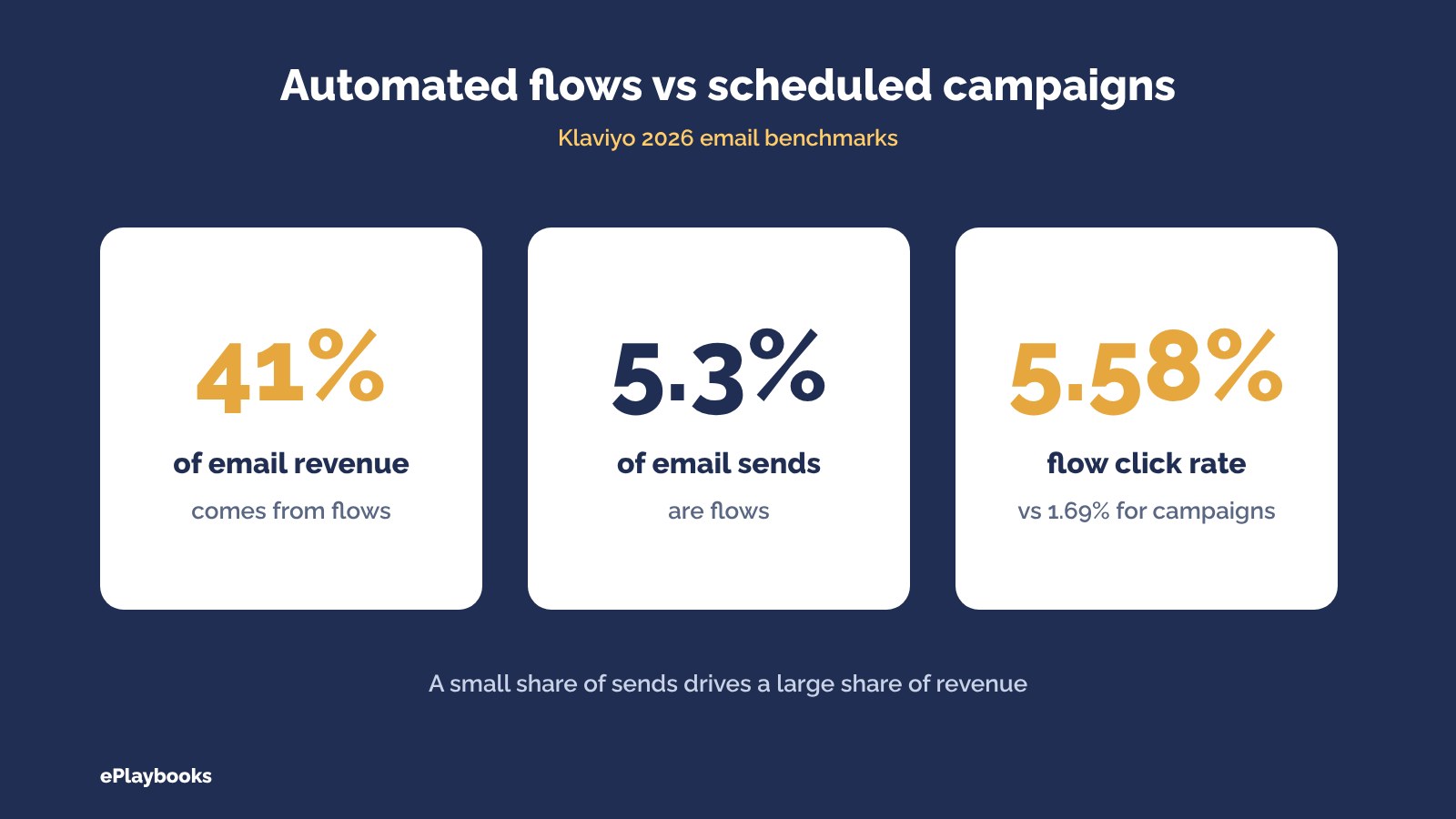
- At the heart of email marketing are email sequences, a series of automated emails triggered by customer behavior. In Klaviyo’s 2026 benchmarks, automated flows drove nearly 41% of email revenue from just 5.3% of sends.
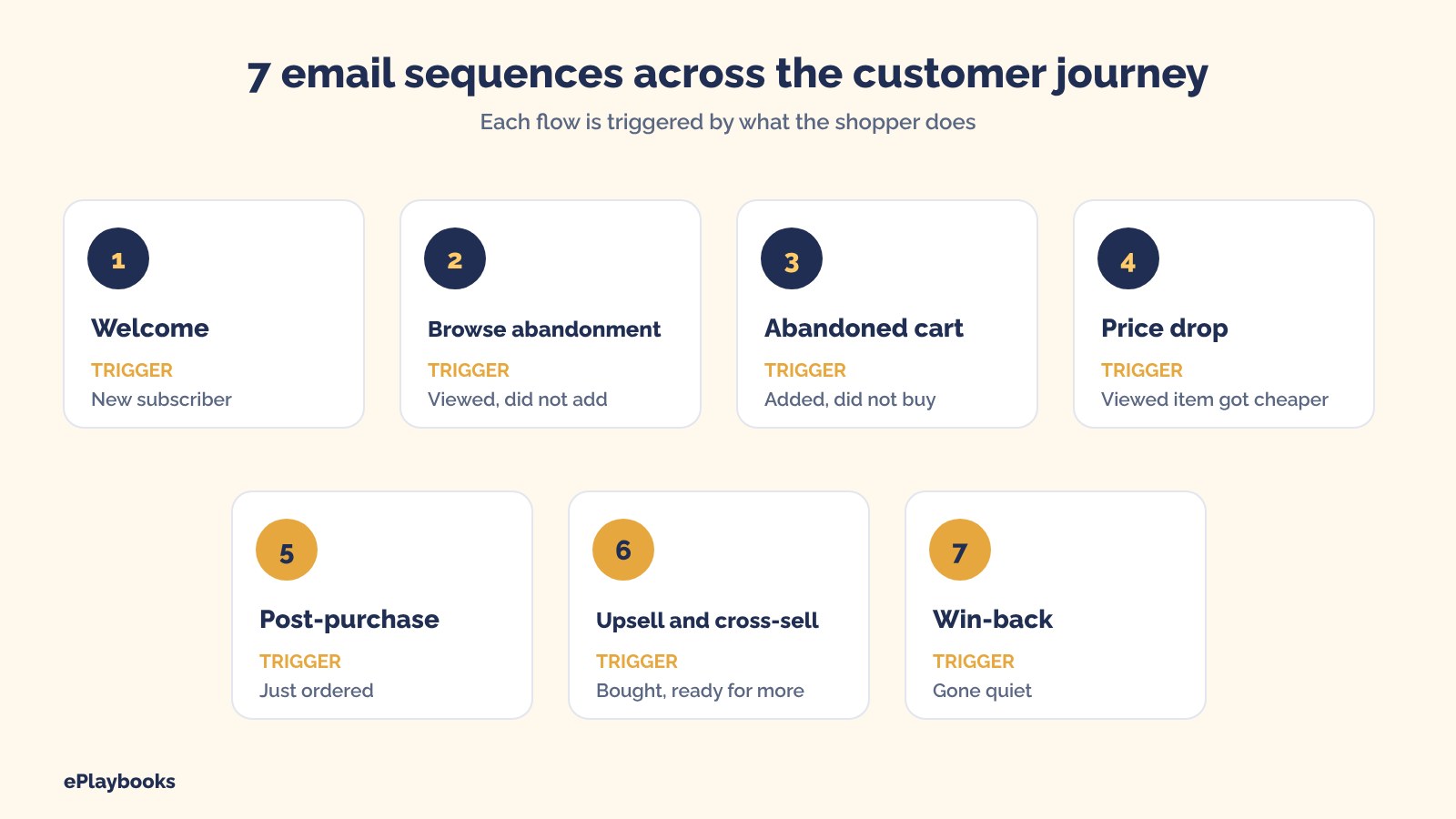
- Build sequences around the customer journey, not just promotional campaigns. Implement seven essential sequences: welcome, browse abandonment, abandoned cart, price drop, post-purchase, upsell and cross-sell, and re-engagement.
- Email sequences work best as part of a broader ecommerce marketing strategy. Pair email with SMS and your other channels, and track revenue, conversions, clicks, and engagement to see what to optimize.
What if a small percentage of your emails could generate a disproportionately large share of your ecommerce revenue?
Klaviyo’s 2026 email benchmarks show that automated flows generated nearly 41% of total email revenue from just 5.3% of sends. Flows also delivered an average click rate of 5.58%, compared with 1.69% for campaigns. In other words, automated, behavior-based emails can become one of the most efficient revenue engines in your ecommerce marketing strategy.
We tell our clients at ePlaybooks that the success of your email marketing campaign relies heavily on understanding your customer journey. The goal is not simply to send more emails. It is to create automated customer journeys that recover missed sales, increase repeat purchases, and generate revenue while your team focuses on other parts of the business.
In this guide, we cover the basics of ecommerce email marketing, the seven email sequences every ecommerce brand needs (including several underused flows), how AI can make them smarter, how to set them up, which metrics to track, and proven strategies to get more from every send.
Email marketing: The basics
Email marketing involves sending promotional messages to targeted email list subscribers to increase brand awareness, build relationships, and boost sales. For ecommerce brands, it is a way to promote your products to both new and existing customers. At its core, email marketing is about building customer relationships that turn subscribers into buyers, and buyers into repeat customers.
The foundation for email marketing is an email subscriber list of people who have shown interest in your brand, plus an email service provider to send and manage your campaigns. Once you have both, you can reach your audience directly in their inbox, with no algorithm in the way.
There are several types of ecommerce emails. Here are three main types to include in your strategy:
Promotional emails
Think of product launch emails, discount emails, and limited-time offers. Promotional emails aim to sell to existing customers and convert leads into customers.
Transactional emails
These emails notify customers about their transactions, such as order confirmations and shipping updates. They build trust by keeping customers informed.
Re-engagement emails
These emails target customers who haven’t bought from you in a while. You can send coupons and other incentives to encourage them to buy from you again.
Benefits of email marketing for ecommerce
It drives traffic to your website and landing pages
Your ecommerce business relies on healthy traffic, and email is a powerful way to send people to your website and landing pages. When subscribers get valuable emails and enticing offers, they click through to take advantage of them. For example, an email promoting a 40% discount on selected clothing items is sure to pique your subscribers’ interest and drive more traffic to your store.
It is personal
Customers increasingly expect personalized shopping experiences. Using customer data, you can send highly targeted emails based on browsing behavior, past purchases, or location. For instance, if a customer abandons their cart, an automated reminder can bring them back to complete the purchase. When customers feel understood and valued, they are more likely to shop with you again.
It is cost-effective
Compared with paid ads or influencer campaigns, email is one of the most cost-effective channels, because you are reaching people who already opted in to hear from you. It helps you capture and nurture leads, and it boosts customer retention, which reduces what you spend acquiring new customers.
It builds brand awareness and trust
Regular, value-driven communication positions your brand as reliable and trustworthy. By sharing helpful tips, product updates, or behind-the-scenes content, you keep your audience engaged beyond promotions and keep your brand top of mind when customers are ready to buy.
What is an email sequence?
An email sequence is a series of automated emails triggered by a specific customer action, behavior, or stage in the buying journey. Sequences guide customers through awareness, interest, desire, and action.
For example, a new subscriber might receive a welcome sequence. A shopper who views a product without purchasing can enter a browse abandonment sequence. Someone who adds an item to their cart but leaves can receive an abandoned cart sequence. Once you set a sequence up, it runs automatically in the background.
The key difference between an automated flow and a regular email campaign is context. Campaigns are usually sent to a broader audience at a predetermined time, while flows respond to individual customer behavior.
Why email sequences matter for ecommerce
Automated email flows can help ecommerce brands:
- Recover revenue from shoppers who do not purchase during their first visit.
- Turn new subscribers into first-time customers.
- Increase repeat purchases and customer lifetime value.
- Recommend relevant products based on customer behavior.
- Re-engage customers who have stopped purchasing.
- Capture demand for products that return to stock.
- Notify interested shoppers when prices fall.
- Personalize communication without manually creating every message.
The biggest advantage is that these activities can happen automatically. Once your flows, triggers, segmentation, and messaging are properly configured, your email program keeps working in the background.
Related: How to Use Email Marketing to Increase Amazon Sales
7 types of email sequences for your ecommerce brand
Here are the essential email sequences every ecommerce brand should have to drive engagement, build loyalty, and boost sales:
- Welcome email sequence
- Browse abandonment sequence
- Abandoned cart email sequence
- Price-drop email sequence
- Post-purchase email sequence
- Upsell and cross-sell email sequence
- Re-engagement and win-back sequence
Welcome email sequence
The welcome sequence is your first impression. When someone joins your email list, they have already shown some level of interest in your brand. Instead of leaving them waiting for your next promotional campaign, use a welcome flow to introduce your brand, share your story, and guide them toward a relevant product. A simple welcome sequence might include:
- Email 1: Welcome the subscriber and introduce the brand.
- Email 2: Highlight best-selling products or your core value proposition.
- Email 3: Address common customer problems and show how your products solve them.
- Email 4: Add reviews, testimonials, user-generated content, or other trust signals.
- Email 5: Present a compelling offer, such as a first-order discount, or a clear next step.
Your welcome flow is also where nurturing happens. Buying guides, how-to content, and customer stories show subscribers how to use your products and why they solve their problems, which moves them closer to a first purchase.
Your welcome flow should not feel like five versions of the same sales pitch. Use the sequence to answer the questions a new customer is likely to have: Who are you? What makes your products different? Can I trust you? Which product should I start with?
Browse abandonment sequence
Browse abandonment is one of the most underbuilt ecommerce flows. A shopper can visit a product page, examine several products, and leave without adding anything to their cart. That does not necessarily mean they are uninterested. They may be comparing products, checking reviews, waiting for payday, or simply getting distracted.
A browse abandonment sequence gives you another opportunity to bring that shopper back. The first email can remind them of the product they viewed. A second can provide additional information, reviews, product benefits, or related products. Depending on the product and buying cycle, you can then follow up with stronger social proof or a relevant incentive.
Keep the messaging personalized. If someone browsed running shoes, show them the running shoes they viewed rather than sending a generic "Come back to our store" email. This flow is especially useful for brands with significant website traffic because it lets you monetize interest that would otherwise disappear after the visitor leaves your site.
Abandoned cart email sequence
Shoppers often add products to their cart and leave without buying. An abandoned cart sequence sends reminders to recover those lost sales.
The first email can simply remind them about the items they left behind, with the products shown, a catchy subject line, and a strong call to action. A second email can reinforce the product's value with reviews, benefits, shipping information, or answers to common objections. A final email can create urgency or, where appropriate, introduce an incentive such as a discount or free shipping.
You don't need to discount every abandoned cart. If customers learn that abandoning their cart always results in a coupon, they may start waiting for the discount. Instead, use the sequence to remove purchase friction and remind shoppers why they wanted the product in the first place.
Price-drop email sequence
Price-drop emails target shoppers who have already shown product-level interest, making them a high-intent opportunity to recover demand that would otherwise go cold. They are another underused opportunity for ecommerce brands.
A shopper may browse a product repeatedly but decide not to purchase because the price is too high. When that price drops, you have a strong reason to bring that shopper back. A price-drop sequence is triggered when the price of a product a customer previously viewed falls below a threshold you set. The email can include:
- The product they were interested in.
- The previous and current price.
- The amount or percentage saved.
- Relevant product benefits.
- A direct call to action to purchase.
The key is relevance. You do not need to tell every subscriber that a product is cheaper. Notify the people who have already shown interest in that product. This turns price changes into automated demand-generation opportunities.
Post-purchase email sequence
The customer journey doesn't end at checkout. A post-purchase sequence helps you strengthen the customer relationship, improve the buying experience, and create opportunities for repeat purchases. Your sequence can include order and shipping updates, product education, usage tips, review requests, customer support information, and recommendations for complementary products.
The priority should be helping customers get value from what they purchased. Once you've reinforced that experience, you can introduce relevant products that encourage another purchase.
Upsell and cross-sell email sequence
After a purchase, upsell and cross-sell emails recommend upgrades or related products to increase your average order value and bring customers back. Base recommendations on what the customer bought, and time them around when they are likely to need a refill, an accessory, or a complementary item.
For example, someone who purchases a camera might receive recommendations for a tripod, memory card, or camera bag. A skincare customer might receive recommendations for complementary products that fit their existing routine. AI-powered product recommendations can make these flows more relevant by choosing products based on each customer’s behavior. The goal is not to push more products to every customer. It is to identify what each customer is most likely to need next.
Re-engagement and win-back sequence
Customers naturally become inactive. They may stop purchasing because their needs have changed, they found another brand, or they simply haven't had a reason to return.
Re-engagement emails target customers and subscribers who haven’t opened your emails or bought from your store in a while. Remind them what makes your brand valuable, share new arrivals or personalized recommendations, highlight customer reviews, or offer a carefully targeted incentive.
Don't keep emailing inactive customers indefinitely. If someone consistently ignores your messages, use engagement data to decide when to suppress them from future marketing emails, which also protects your deliverability.
How AI can make ecommerce email sequences smarter
Automation already helps ecommerce brands send the right emails at the right time, but AI takes personalization and optimization a step further. Here is how Klaviyo, one of the most widely used ecommerce email platforms, uses AI across send timing, product recommendations, and email content.
Personalized send time
Klaviyo's Personalized Send Time uses AI to predict when each subscriber is most likely to engage with an email. Instead of sending a message to everyone at the same time, it picks an individual send time within a delivery window you set.
This is particularly useful for non-urgent emails where maximizing engagement matters more than reaching your whole audience at once.
AI product recommendations
Klaviyo's AI product recommendations use browsing and purchase behavior to suggest the products most relevant to each shopper. This can make post-purchase, cross-sell, win-back, and promotional flows more personalized and relevant.
AI subject line generator
Klaviyo's AI subject line generator suggests subject lines based on the content and context of your email. You can edit, regenerate, and test different options to find what resonates with your audience.
The goal isn't to let AI replace your email strategy. Use it to speed up repetitive tasks and improve personalization while keeping your customer segments, triggers, messaging, and overall strategy under human control.
Use the Klaviyo MCP server to set up and optimize flows faster
The Klaviyo MCP server connects compatible AI clients to your Klaviyo data and tools, so marketers can analyze performance and carry out supported tasks using natural-language prompts. Klaviyo documents connections for Claude, ChatGPT, Cursor, and VS Code, with configurable tools, scopes, and access controls.
For ecommerce teams preparing for 2027, this can make setting up and optimizing automated email journeys much faster. Instead of digging through dashboards, marketers can ask questions such as:
- Which flows generated the most revenue in the last 30 days?
- Which automated sequences have the lowest conversion rates?
- Where are our abandoned cart flows losing customers?
- Which customers should we prioritize for a win-back campaign?
- Can you draft a campaign for customers who viewed our new collection?
The biggest advantage is speed: moving from data to insight to action without hours of manual reporting. Human oversight still matters, especially for customer-facing content and any change to customer data or live marketing workflows.
How to set up email sequences to improve ROI
Here’s a step-by-step guide to setting up email sequences that improve your return on investment.
Set clear goals
Start with clear, measurable goals, such as increasing your repeat purchase rate or recovering more abandoned carts. Your goals decide which sequences you build first and which metrics you watch.
Choose the right email marketing platform
Choose an email marketing platform built for ecommerce, such as Klaviyo, Mailchimp, or Omnisend. Look for automation, segmentation, behavioral triggers, analytics, personalization, and a native integration with your store platform so purchase and browsing data flows in automatically. Klaviyo, for example, offers prebuilt flows for welcome series, browse and cart abandonment, back in stock alerts, post-purchase follow-ups, and winback, and can combine email and SMS in one flow.
For larger ecommerce programs, look beyond the number of templates or emails included in a plan. Consider how well the platform handles customer data, product catalogs, segmentation, attribution, automation, and integrations.
Grow and segment your list
Gather emails by offering value in exchange for an email address, such as a coupon, a newsletter, or early access to launches, using popups and signup forms on your site. Then segment your audience based on behavior, purchase history, or demographics so each sequence reaches the right people.
Understand your customer journey
Outline your key customer touchpoints from first-time visitor to loyal repeat buyer: joining your list, browsing, abandoning a cart, purchasing, and becoming inactive. Each touchpoint is a trigger for one of your sequences.
Build the essential email sequences
You do not need to build every flow at once. Start with the flows closest to revenue: welcome, browse abandonment, abandoned cart, post-purchase, and win-back. Then add price-drop and advanced cross-sell flows as your data and customer journey mature. Create any landing pages your emails link to before you switch the sequences on.
Make sure your sequences fit into your wider marketing strategy, working alongside your paid advertising, SEO, SMS, social media, and loyalty programs rather than competing with them. This is an important part of building an ecommerce marketing plan that integrates email sequences. Build progressively around the customer behaviors and revenue opportunities that matter most, instead of a complicated system your team cannot maintain.
Track, test, and optimize
Treat your email marketing as an ongoing experiment. A/B test subject lines, send times, and incentives, monitor the metrics below for each sequence, and adjust what isn’t working. Do not look only at open rates. A flow with a lower open rate can still generate more revenue if it attracts higher-intent shoppers.
Which email marketing metrics should you track?
Track these metrics for every sequence and campaign to see what is working:
| Metric | What it tells you |
|---|---|
| Open rate | The share of recipients who open your email. It reflects how compelling your subject lines and sender name are. Some email apps preload images, which can inflate opens, so don’t rely on this metric alone. |
| Click-through rate | How many subscribers clicked a link in your email, a direct sign of engagement with your content. |
| Conversion rate | The percentage of recipients who completed your desired action, such as making a purchase or downloading a resource, after clicking through. |
| Bounce rate | Whether emails were delivered. Soft bounces are temporary issues (for example, a full inbox or a message that is too large). Hard bounces are permanent failures, such as invalid or non-existent addresses. |
| Unsubscribe rate | How many recipients opted out after a message. A high rate may mean your content isn’t meeting expectations or you are targeting the wrong audience. |
| Revenue generated | How much revenue each campaign or sequence brings in, which links your email program directly to ROI. |
| Revenue per recipient | How much revenue a flow or campaign generates relative to the number of people who received it. Useful for comparing flows of different sizes. |
| Flow contribution | The share of your email revenue that comes from automated flows versus campaigns, which shows how much behavior-based automation is driving. |
9 email sequence best practices
Set a clear goal
Give every sequence, and every email within it, one job, such as getting a first purchase or a review. A clear goal makes it easier to write the email and to measure whether it worked.
Use behavioral triggers
Avoid sending every customer the same sequence. Use purchase history, browsing activity, product interest, engagement, and other signals to decide which message someone receives.
Personalize beyond the first name
Adding someone's first name is not enough to make an email personal. Use the products they viewed, products they purchased, categories they engage with, and predicted preferences. AI features such as personalized send times and product recommendations can take this further by adapting timing and products to each shopper.
Pay attention to your subject lines
Your subject line decides whether your email gets opened. Keep it short, specific, and relevant to the trigger, and test different versions to see what your audience responds to.
Add valuable content
Not every email should be a sales pitch. Mix helpful tips, product education, and inspiration with your offers so subscribers look forward to hearing from you. A common guideline is the 80/20 rule: about 80% value and 20% promotion.
Do not over-discount
Discounts can recover revenue, but they should not become the default solution. Before offering a coupon, try reminding customers about product value, highlighting reviews, addressing objections, reinforcing urgency, or showing relevant recommendations.
Include a call to action
Your subscribers should know exactly what to do next. A call to action is usually a button or link, and it should be clear, easy to spot, and focused on one goal. Too many action points can confuse readers. Use A/B testing to find the call to action your subscribers respond to best.
Keep mobile in mind
Many shoppers read email on their phones, and even slight friction can make them click away. Use short subject lines, concise copy, clean single-column layouts, clear product images, and buttons that are easy to tap, and preview every email on mobile before you send it.
Pair email sequences with SMS marketing
SMS can strengthen your customer journey, but how SMS marketing pairs with email sequences to recover more revenue depends on using each channel for what it does best. Email gives you room for product education, storytelling, recommendations, and detailed offers, while SMS delivers short, time-sensitive reminders and alerts. For example, an abandoned cart email could provide product details and social proof, followed by an SMS reminder for a shopper who has opted into text marketing. Used carefully, the two channels reinforce each other without repeating the same message.
More strategies to nail your ecommerce email marketing
Once your core sequences are running, these strategies can help you get even more from email.
Personalize with segmentation
Plenty of other brands are emailing your subscribers too. Personalization helps you stand out. You can personalize your emails in three main ways:
- Demographic: using factors like age, gender, and income to tailor recommendations.
- Contextual: based on where the customer is in their journey, for example shoppers who are considering a purchase.
- Behavioral: using purchase history or website behavior.
Use one or more of these to create emails that resonate with your audience.
Send promotional emails occasionally
When you launch a new product or run a sale, build a campaign around it. Segment subscribers by purchase behavior, especially around holiday seasons. But find the sweet spot: too many promotional emails make your brand look salesy and drive unsubscribes.
Reward repeat buyers
Repeat buyers and loyal subscribers are key to your growth, and they spread the word to friends and family. Reward them with exclusive offers, early access, or extra after-sales support so they feel valued, not just discounted.
Send back-in-stock and wishlist emails
Running out of stock can work in your favor. Add a wishlist or "notify me" button to your store so you know who is interested in a product, then email those customers as soon as it is back in stock to recover sales you would otherwise lose.
A/B test your emails
A/B testing compares two or more versions of an element to see which performs better. Test subject lines, calls to action, images, layouts, send times, send delays, offers, product recommendations, and email frequency, then roll out the winning version. AI tools can speed this up, but your own customer and revenue data should decide what works for your brand.
Keep growing your email list
Subscribers can unsubscribe at any time, so keep adding new ones. Use newsletter popups, discounts, and giveaways, and always offer something valuable in exchange for an email address.
Final thoughts
Email marketing remains a powerful way to reach customers, recover missed sales, and increase repeat purchases. With the right sequences, you can guide shoppers from their first interaction with your brand through purchase, retention, and re-engagement, with much of the process running automatically.
Start with the customer journey, build the highest-impact flows first, and keep testing and improving them. Then connect email with SMS and the broader ecommerce marketing strategies that work alongside email automation to create a more connected customer experience.
If you need help building and optimizing automated customer journeys, ePlaybooks’ ecommerce growth and email marketing services can help you create an email strategy that supports your wider ecommerce growth goals.

