

Key takeaways:
- Sellers benefit from Prime access, logistics support, and scalability, but must account for multiple fees that impact overall profitability.
- While the average increase is small ($0.08 per unit), Amazon introduced more detailed pricing tiers based on size, weight, and price, making cost management more precise.
- Changes include higher inbound placement fees, new bulky size tiers, and a consolidated inbound defect fee, all of which increase costs associated with inefficient shipping practices.
- Sellers can reduce costs by optimizing packaging, improving inventory turnover, and maintaining low return rates, as fees are increasingly tied to performance and operational efficiency.
Selling with FBA on the US marketplace comes with numerous benefits. For one, Amazon FBA makes you eligible to sell to over 200 million Prime members who are willing to pay more for faster delivery. You also don’t have to worry about paying for a storage facility or handling any shipping logistics.
Fulfillment by Amazon(FBA) helps you handle order fulfillment and logistics while you focus on how to generate more income for your business. However, these numerous benefits do come at a cost. In fact, Amazon has unveiled changes to its Amazon FBA fees for 2026.
So what are these Amazon FBA fee changes? In this ePlaybooks guide, we will give you a breakdown of these fees, so you can effectively create a working budget, sell with fulfillment by Amazon, and increase company sales.
Changes to Amazon FBA fees in 2026
Amazon updated its Fulfillment by Amazon (FBA) fee structure. While fees are increasing in certain areas, the goal is to reduce costs and improve fulfillment speed.
Amazon Fulfillment Fees
One of the biggest tasks for any Amazon FBA Seller is handling orders and shipping products to customers. This can be time-consuming, especially as Amazon sales increase and your business expands. This is where the FBA service comes in. Apart from storing your products, Amazon helps you store your products in fulfillment centers. They also ship these products to your customers. This means you can focus on other aspects of your business.
However, Amazon charges a fee for storing and shipping your products. These fees are primarily based on the product's weight.
Fulfillment fee changes in 2026
In 2026, fulfillment fees increased by about $0.08 per unit on average. This is less than 0.5% of the average product price. The increase isn’t uniform and depends on your product's price. Amazon introduced more detailed size and price tiers. Fees now better reflect weight, dimensions, and handling complexity. This means inefficient packaging can cost you more. This excludes the Apparel product category.
FBA inbound placement service fee
- For standard-size items, the inbound placement service fee will rise by an average of $0.05 per unit when sellers choose the minimal shipment splits option. Amazon is also refining its fee structure by introducing two shipping weight bands for small standard-size products and five distinct weight bands for large standard-size items weighing between 3 and 20 lbs.
- The existing Large Bulky category will be divided into two separate tiers: Small Bulky and Large Bulky. With this change, sellers using minimal shipment splits for the new Large Bulky tier can expect an average fee increase of $0.27 per unit. However, the Amazon-optimized shipment splits option will remain available at no additional cost.
- Amazon is consolidating how it charges for inbound shipment issues. Shipments that fail to arrive, arrive late (abandoned), or are sent to the wrong fulfillment center will now incur a single inbound defect fee averaging $0.60 per unit.
Storage fees
One of the many benefits of using Amazon FBA is that you don’t have to store your inventory. This is beneficial, especially if you don’t have a space to store a large number of items. What’s more, you don’t need to pay to rent out a large storage facility. All you need to do is send your inventory to Amazon and have them store it for you. You can also have your supplier ship your products directly to Amazon. Of course, to get these benefits, you will need to pay for them.
Monthly storage fee
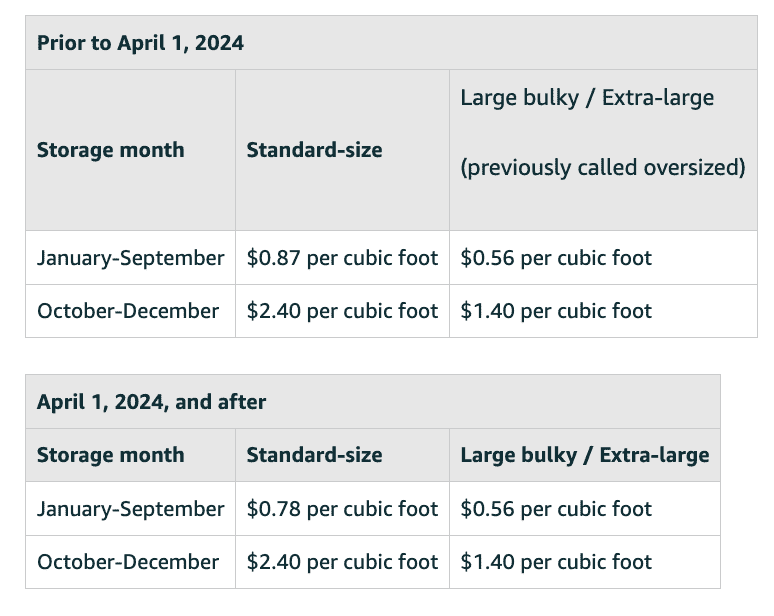
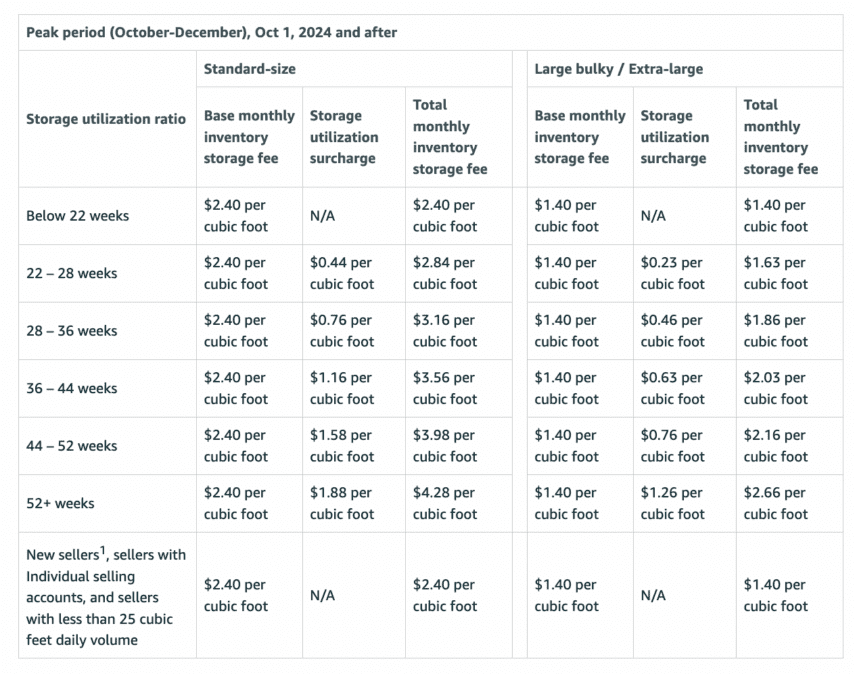
Amazon storage fees remain unchanged. Off-peak monthly inventory storage fees (January-September) for standard-size products are $0.09 per cubic foot. Off-peak monthly inventory storage fees for large, bulky, or extra-large products, as well as peak monthly inventory storage fees for all product categories, remained unchanged.
Here’s a breakdown of what these fees will look like:
Amazon storage utilization surcharge
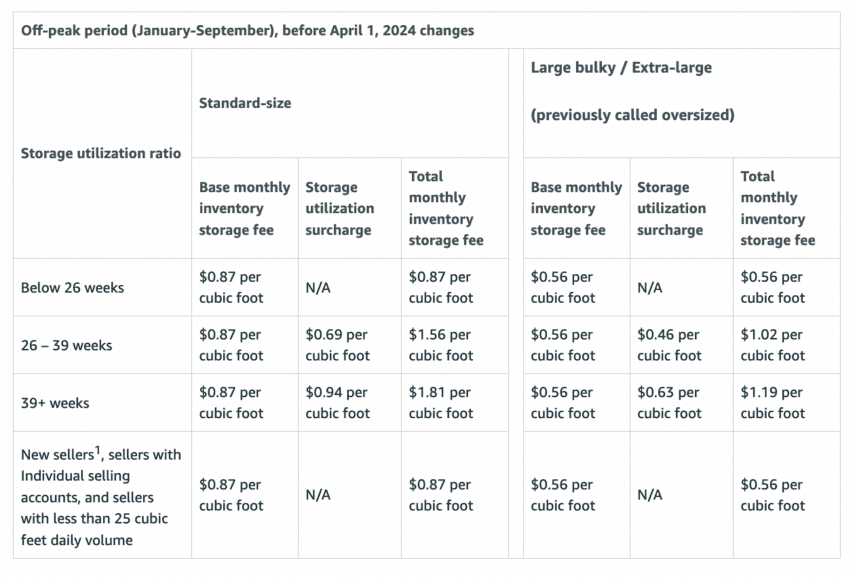
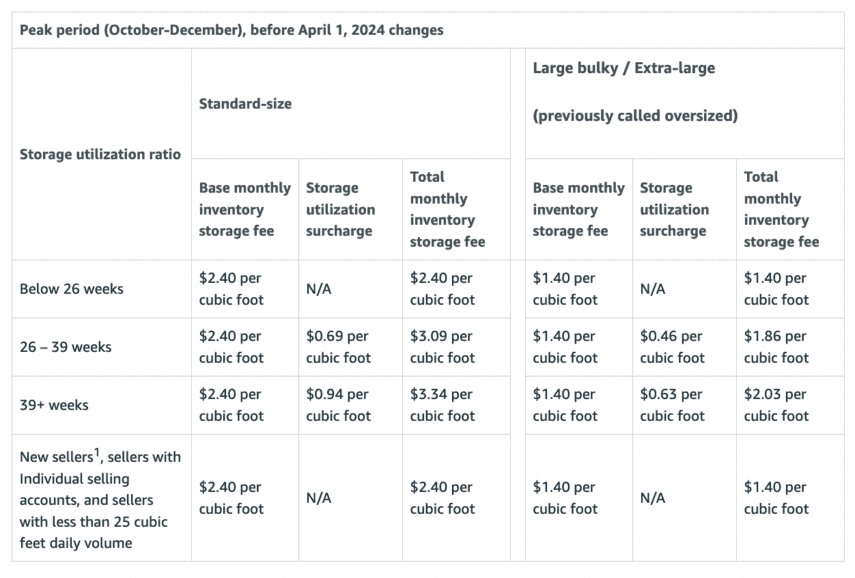
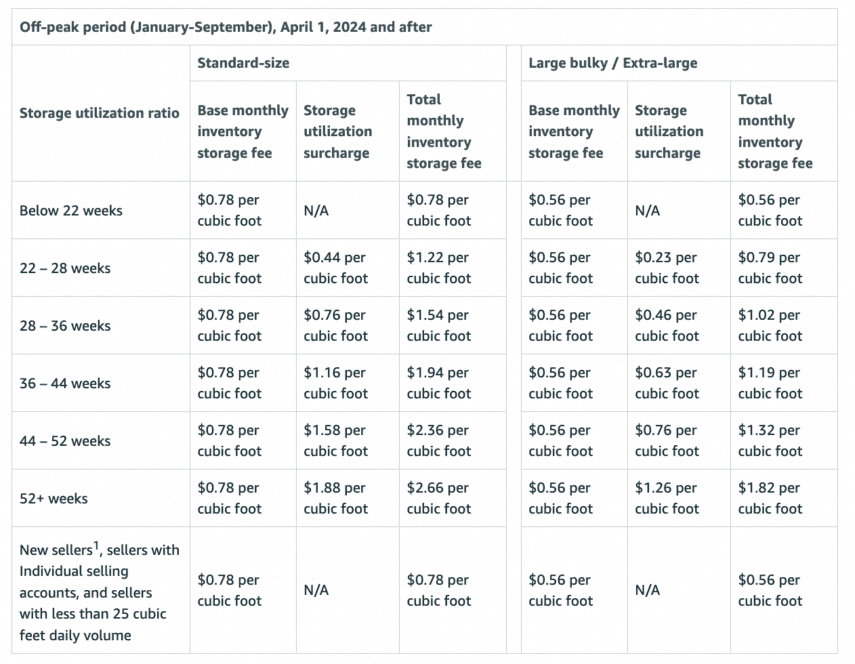
There are no updates to storage utilization surcharges for 2026. These fees apply when sellers hold more inventory in Amazon’s fulfillment centers than their recent sales performance justifies, essentially penalizing excess stock relative to demand.
The surcharge is determined by several factors, including the product’s size category, the time of year, total inventory volume, average daily units stored, the seller’s storage utilization ratio, and whether the item is classified as a dangerous good. Sellers can monitor their current storage utilization ratio directly from the FBA dashboard within Seller Central. This surcharge applies to Professional sellers whose storage utilization ratio exceeds 22 weeks (approximately 5 months).
The storage utilization ratio is calculated by dividing the average daily inventory volume by the average daily shipped volume over the past 13 weeks, based on size tier 15. Inventory aged between 0 and 30 days is excluded from the surcharge. Also, products auto-replenished by Amazon Warehousing and Distribution (AWD) are eligible for a storage utilization surcharge waiver.
FBA aged inventory surcharge
Amazon has adjusted its long-term storage charges for older inventory. Products stored between 271 and 365 days (roughly 12 to 15 months) will now incur a higher fee, increasing by $0.15 per unit to $0.30 per unit each month.
For inventory that remains in fulfillment centers beyond 15 months (365+ days), Amazon applies a more aggressive charge: $0.35 per unit per month or $7.90 per cubic foot, whichever amount is greater. This new tier reflects Amazon’s effort to better account for the cost of storing slow-moving inventory.
To avoid these additional charges, sellers should regularly review their Inventory Age Report and take steps to improve turnover and move aging stock more quickly.
Amazon FBA removal and disposal fees
When an item is not sellable, Amazon sends the item back to the seller to dispose of. The fee charged when Amazon returns those items is called a Removal fee.
On the other hand, Disposal fees are the fees charged by Amazon to destroy items that are unsellable for the seller.
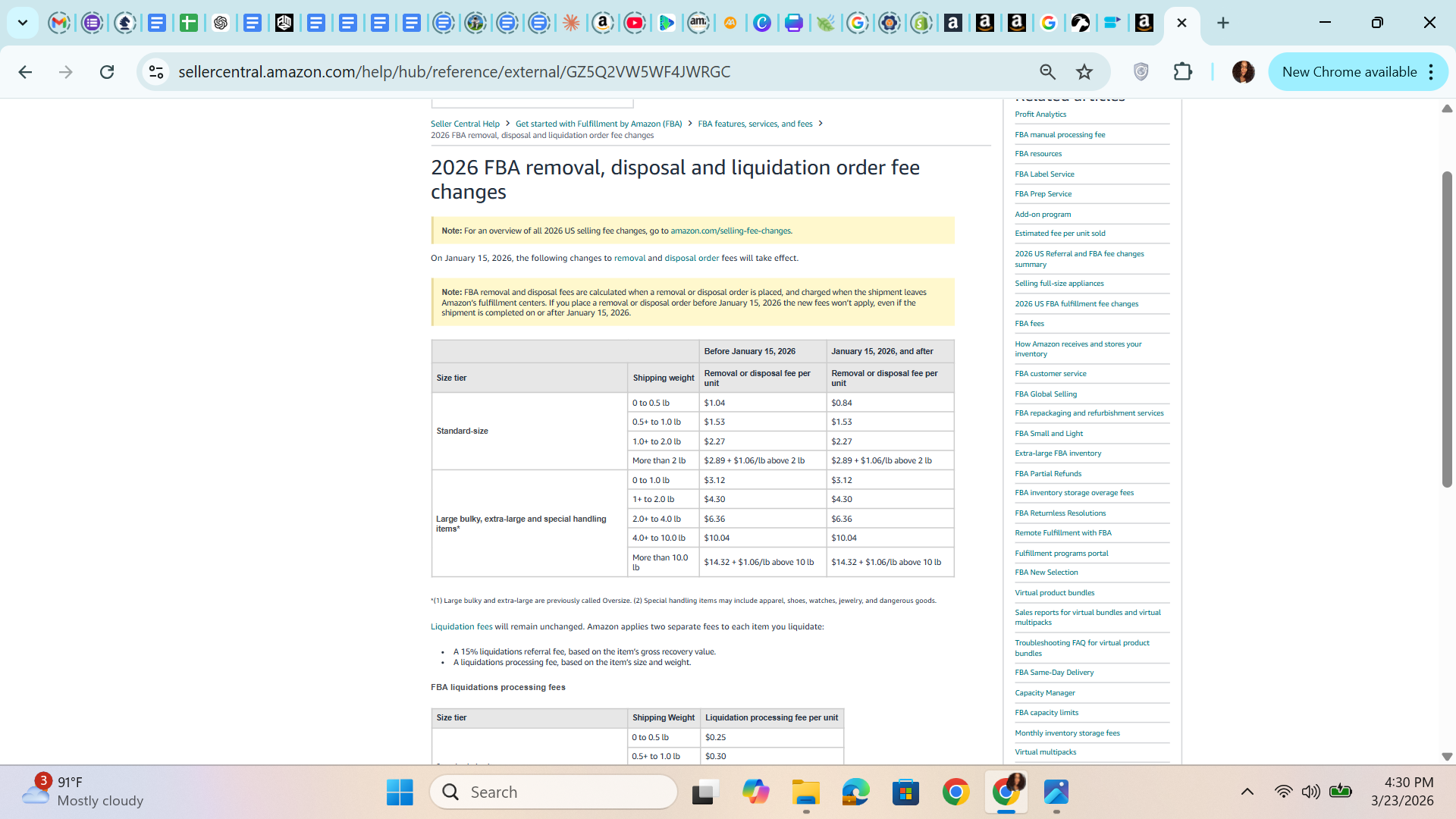
Amazon has lowered the cost of removing or disposing of standard-size aged inventory weighing less than 0.5 lb. The fee has been reduced by $0.20 per unit, bringing the new rate to $0.84.
This adjustment is designed to make it more affordable for sellers to clear out excess or slow-moving inventory on time. Here's a breakdown of the 2026 Amazon FBA removal and disposal fees in the table below:
Amazon referral fees
Amazon is one of the largest ecommerce sites in the world. It has a large customer base, giving you access to a huge number of potential customers. When you sell a product on Amazon, they collect a profit. This is Amazon’s commission for letting you sell on their platform. These few vary depending on the product category. The referral fee is based on the total sales price, including the price of the item and the price of shipping and gift wrapping.
Specifically, for apparel items under $15, Amazon reduced referral fees to 5% from 17%. For items priced between $15 and $20, Amazon decreased referral fees to 10% from the previous 17%. For items above $20, the referral fee is 17%. It's important to note that referral fees for other Amazon products remained unchanged.
If you belong to other categories, your referral fees stay the same. Here are a few referral fee charges for various categories on Amazon:
- Beauty, Health, and Personal Care: 8% for products with a total sales price of $10.00 or less, and 15% for items with a total sales price greater than $10.00.
- Clothing and Accessories: 17%
- Consumer Electronics: 8%
- Camera and Photo: 8%
- Home & Garden: 15%
- Kitchen: 15%
- Office Products: 15%
- Toys & Games: 15%
- Electronics Accessories: 15% (for the portion of the sales price under $100) and 8% (for the portion of the sales price over $100).
It is also important to consider the taxes you will pay on your earnings from Amazon.
Amazon Return Processing Fee
Amazon applies return processing fees to certain categories where customers are eligible for free returns. These charges help offset the costs associated with handling returned items, including inspection, repackaging, and returning products to inventory.
Instead of charging a fee for every individual return, Amazon now evaluates return rates at the product level. A fee will only be applied if a product’s return rate exceeds a specific threshold set for its category. This means sellers with well-performing products and low return rates can benefit from reduced or no return-related charges.
The return rate is determined by dividing the number of units shipped in a given month by the number of customer returns received during that month and the following two calendar months.
What can you do about the FBA price increase?
The Amazon FBA fee changes may significantly affect sellers either positively or negatively. While there is no way to bypass these fees, you can reduce their impact on your business. Here are a few ways you can do that:
- Ensure you measure and record the right product dimensions accurately. You don’t want Amazon to charge you extra, thinking your product is larger or heavier than it is.
- Amazon charges fees for preparing products for shipping. You can prepare all your products before sending them to Amazon fulfillment centers to cut down costs. However, ensure they are properly labeled to avoid them being sent back. You might want to get an Amazon expert to help you label your products according to standards.
- Maximize your storage by taking out items that have stayed too long and are contributing extra costs. Do all you can to ensure that your inventory moves out of the store as quickly as possible.
- You might also want to consider FBM (Fulfillment by Merchant) for some items, like slow-moving items or heavy items, to avoid extra charges and bypass the FBA fees.
- Amazon's fee structure is subject to change, and new fees or fee adjustments may be introduced. Staying informed about these changes through Amazon's official announcements and resources can help you plan your strategies accordingly and minimize the impact of price increases on your operations.
Conclusion
At the end of the day, your goal is to make a profit selling on Amazon. Knowing the expected costs will help you create a working budget and help you make smart choices.
Hopefully, this article gives you an idea of the changes to come. If you have any questions or need professional help tracking which products are profitable to increase your profit margins, you can speak to an expert on ePlaybooks right away.

